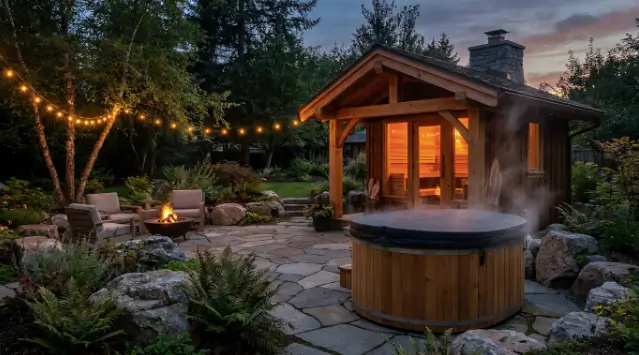
A sauna kit built from cedar or spruce handles freezing temperatures without structural issues, but a cold climate adds real costs on top of the base price: roughly 20 to 40 percent longer heater run times to reach and hold temperature, a one-time $300 to $1,200 for extra insulation and a frost-resistant base, and, for wood-fired kits, a steady supply of dry firewood through the season. None of these costs are optional line items in a place with real winters. Skipping them is the most common reason a cold-climate sauna kit runs poorly or develops moisture problems by its second season.
What Does a Frost-Resistant Base Cost?
A gravel or paver pad that works fine in a mild climate can heave in a region with a deep frost line, tilting the structure and stressing panel joints over a few freeze-thaw cycles. In cold regions, a base with a compacted gravel layer below the frost line, or a set of frost-rated helical piers under a deck platform, typically adds $400 to $1,000 over a simple warm-climate pad, depending on how deep local frost runs and whether a contractor is needed. Skipping this step to save money upfront is a common regret, since correcting a heaved foundation after the fact means disassembling panels that were never designed to come apart twice. Local frost depth varies widely, from under a foot in a mild northern climate to four feet or more in the coldest inland regions, so it is worth asking a local contractor or checking the county building code rather than guessing at a national average.
What Extra Insulation Does a Cold-Climate Kit Need?
Most kits ship with a standard foil-faced insulation layer behind the interior paneling, sized for a moderate climate. In a region with regular sub-freezing nights, upgrading that layer, or adding a double-wall option where the manufacturer offers one, typically costs $200 to $500 in materials and cuts heater run time noticeably since less heat escapes through the walls. Door seals and any window gasket also matter more here than in a mild climate, since a worn seal that barely registers as a draft in a 40-degree yard becomes a real heat leak once the outside temperature drops below freezing. Checking seals each fall before the first hard freeze, rather than after noticing the room will not hold heat, catches a worn gasket while a simple strip replacement still fixes it.


The Real Winter Cost List
- Frost-resistant base or piers: $400 to $1,000 one-time
- Upgraded insulation and sealing: $200 to $500 one-time
- Extra electricity from longer heater run times: roughly 20 to 40 percent above a mild-climate session, season-long
- Firewood, for wood-fired kits: varies widely by region, often $150 to $400 per cold season if not already on hand
- Snow clearing or a steeper roof pitch option: $0 to $300 depending on kit and region
How Much More Does the Heater Actually Work?
An electric heater sized correctly for a kit’s interior volume in a mild climate has to work harder against colder incoming air and a colder exterior wall temperature, which extends both the initial warm-up time and how often the heater cycles to hold temperature during a session. Sizing up one heater tier above what a mild-climate chart recommends is common practice among cold-region installers specifically to offset this, and it is worth confirming with whichever kit’s sizing guide is being used rather than assuming the standard chart already accounts for a hard winter. SweatDecks’ lineup lists heater kilowatt options by model, useful for comparing whether a given kit offers a step up in heater size for exactly this reason.
Should the Heater Run Wood or Electric in a Cold Climate?
Wood-fired heaters can be cheaper to operate per session if firewood is already available or inexpensive, and many cold-climate owners already have a woodpile from a fireplace or wood stove. The tradeoff is active tending: building and maintaining a fire in freezing wind takes longer and requires more attention than flipping on an electric heater from indoors ahead of time. Electric heat costs more per session in raw electricity, more so with the longer winter run times described above, but it starts reliably regardless of wind or wet firewood and can often be started remotely or on a timer, which matters more in January than it does in June. Firewood that has not been split and dried well in advance is a common cold-climate frustration, since wet or green wood burns poorly and produces more smoke and creosote, so anyone leaning on wood heat through a hard winter should have next season’s wood stacked and covered well before the first freeze.
What Does the Research Say About Sauna Use Across a Full Winter?
Reviews of the sauna literature note that heat and cold exposure both trigger physiological adaptations, and a 2018 review in the American Journal of Physiology specifically discussed how repeated heat exposure, including in cold-climate contexts where sauna use has historically been part of daily life, relates to cardiovascular and thermoregulatory function. An earlier review in The American Journal of Medicine outlined both the reported benefits and the known risks of regular sauna bathing, useful reading for anyone increasing session frequency through a long winter. A 2023 review looking at sauna bathing alongside broader lifestyle factors reinforced that consistency of use, not the outdoor temperature on any given night, is what the associations in the research track.
Frequently Asked Questions
How much more does a sauna kit cost to run in a cold climate? Expect roughly 20 to 40 percent higher heater run time in freezing weather compared to a mild-climate install, plus a one-time cost of $300 to $1,200 for extra insulation, a frost-resistant base, and weatherproofing that a warm-climate kit does not need.
Can a sauna kit sit outside all winter in freezing temperatures? Yes, most cedar and spruce kits are built to handle freezing weather when properly sited on a well-draining, frost-resistant base. The heater and any plumbing need to be protected from freeze damage, and doors and seals should be checked each fall for gaps that let in cold air.
Does snow load affect sauna kit roofing? In heavy-snow regions, a barrel roof sheds snow naturally due to its curve, while a flat or low-pitch cabin roof may need a steeper pitch option or periodic clearing to avoid excess weight. Checking the manufacturer’s rated snow load before ordering is worth the five minutes it takes.
Is wood heat or electric heat cheaper to run in winter? Wood-fired heat is typically cheaper per session in a cold climate if firewood is already on hand or inexpensive locally, but it requires more active tending in freezing weather. Electric heat costs more per session in electricity but requires no fire tending and heats more predictably in wind and cold.
References
- Effects of heat and cold on health, with special reference to Finnish sauna bathing, American Journal of Physiology, 2018
- Benefits and risks of sauna bathing, The American Journal of Medicine, 2001
- Does the Combination of Finnish Sauna Bathing and Other Lifestyle Factors Confer Additional Health Benefits? A Review of the Evidence, Mayo Clinic Proceedings, 2023
By Owen Pruitt